Somewhere in a spreadsheet at U.S. Soccer, a number is sitting that has nothing to do with lifting a trophy: $246,153.85. That’s what each eligible American player, men’s and women’s rosters combined, will pocket from a tournament the USMNT exited in the Round of 16. It’s proof that the 2026 World Cup prize money conversation isn’t only about Spain’s golden night in New Jersey. It’s about who eats and who doesn’t, all the way down the bracket.
Spain’s night, and the number behind it
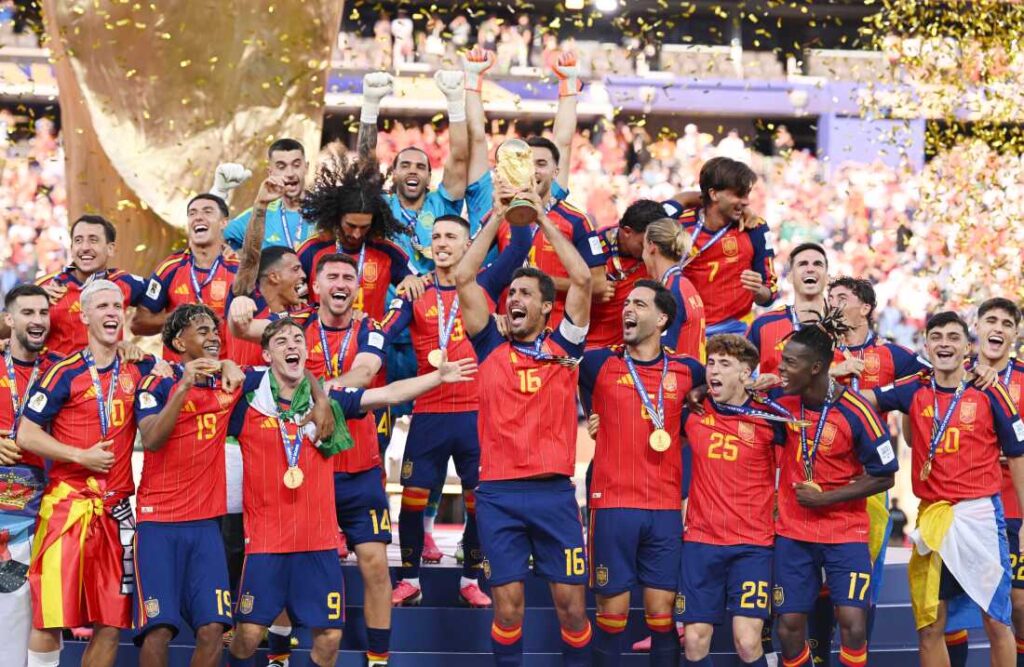
Spain beat Argentina 1-0 in extra time on Sunday, with Ferran Torres scoring the winner in the 106th minute to hand La Roja their second World Cup title. For that, Spain collects $50 million in prize money, the single largest championship payout FIFA has ever handed out. Runner-up Argentina, chasing back-to-back titles with Lionel Messi, takes home $33 million.
Add in the $10 million every finalist already banked for reaching the final and the $1.5 million preparation grant paid to all 48 teams, and Spain’s total FIFA payday climbs to roughly $61.5 million, according to figures reported by Yahoo Sports.
The full 2026 World Cup prize pool
This is the richest World Cup in history by a wide margin. FIFA is distributing a total of $655 million across all 48 teams, with payouts ranging from $9 million to $50 million depending on how far each nation advanced.
Here’s how the money splits:
- Champions (Spain): $50 million
- Runners-up (Argentina): $33 million
- Third place: England secured $29 million by beating France 6-4 in Saturday’s third-place match
- Fourth place (France): $27 million
- Quarterfinal exits (Norway, Belgium, Morocco, Switzerland): $19 million
- Round of 16 exits, including the United States: $15 million
- Round of 32 exits: $11 million
- Group stage exits: $9 million
- Every team, regardless of finish, also received $1.5 million in preparation costs
For scale: Argentina received $42 million for winning the 2022 World Cup in Qatar, and France earned $38 million after winning in Russia in 2018. The champion’s check has grown more than twentyfold since Italy collected $2.2 million for winning in 1982.
Why this actually matters to a player, not just a federation
Prize money headlines usually stop at the federation level, as if the check disappears into a corporate account. It doesn’t, and the U.S. case makes that visible. Under the 2022 collective bargaining agreements between U.S. Soccer and both the men’s and women’s national teams, the $16 million the USMNT earned gets split: 80% divided among roster players from both the men’s and women’s teams, working out to $246,153.85 per player, with the remaining 20% going to U.S. Soccer itself.
That single clause is the real story buried in this year’s numbers. It means a U.S. women’s national team player, who still has to qualify for the 2027 Women’s World Cup, gets paid based on how far the men went in a tournament she didn’t play in. Whether that’s fair or generous depends entirely on where you’re standing, but it proves prize money structures are no longer just about who wins. They’re about who negotiated well before the tournament even started.
Here’s where I’ll take a side
A $50 million winner’s check is a headline. A group-stage team walking away with $9 million plus $1.5 million in prep money is the quieter, more important number. FIFA didn’t just make the pie bigger for 2026, it widened the floor for every federation that qualified, which matters more for growing the sport in countries that will never lift the trophy than another few million on top of Spain’s record haul. The real win of this World Cup’s economics isn’t the $50 million check. It’s the $9 million ones.
So here’s the question worth sitting with: if a first-round exit now pays a national federation $10.5 million, does that change how seriously smaller footballing nations invest in youth programs going into 2030, or does the gap between $9 million and $50 million still make it a rich country’s game?