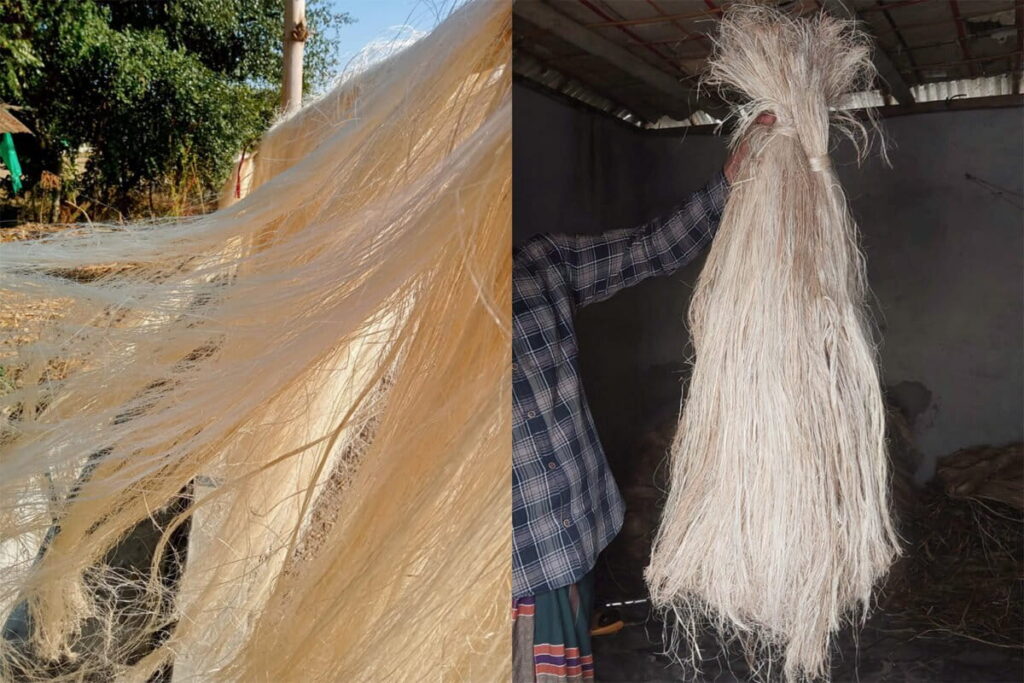
In a field in Pabna, west-central Bangladesh, an entrepreneur is doing something most farmers walk past every day: pulling long, silvery strands out of a banana stem that would normally be hacked down and left to rot. That single stem, worth nothing an hour earlier, is now raw material for a saree, a curtain, or a woven bag.
Multiply that by every banana farm in the country, and you get a number that should make Bangladesh’s textile industry sit up: $94 million.
The Waste Nobody Was Watching
Bananas make up 20% of all fruit crops grown in Bangladesh, and after every harvest, the plant’s stem is treated as leftover junk. But that stem is fiber-rich, and researchers have now measured just how much it’s worth.
According to a study cited by Mongabay, Bangladesh could commercially produce around 37,778 tons of banana fiber, with the potential to generate more than $94 million in export earnings annually. Right now, the country is nowhere close. Bangladesh currently earns only around $1.5 million a year from banana fiber exports, a fraction of the fortune sitting in its fields.
Worth More Than Jute
This isn’t a marginal upgrade over the country’s traditional cash fiber. The price of banana fiber in local and global markets is more than double that of jute fiber, and jute is a crop Bangladesh has built entire trade relationships around.
Banana fiber is already being turned into handicrafts, sarees, curtains, mats, and bags, biodegradable products that fit neatly into a global market hungry for sustainable textiles. Nothing about this requires new land, new water, or a new crop, it requires using what already exists.
A Second Payoff: The Soil Itself
The economics don’t stop at the fiber. Once the fiber is stripped out, the remaining plant matter doesn’t need to be thrown away either. Vermicompost produced from the leftover waste after banana fiber extraction is a nutrient-rich organic fertilizer that can be used in agriculture, horticulture and organic farming.
That’s a closed loop: stem becomes fabric, fabric waste becomes fertilizer, fertilizer feeds the next crop. Rojina Akter, assistant professor at the Asian University of Bangladesh and one of the study’s researchers, said banana fiber production could be highly profitable while promoting sustainable waste management and a circular economy in Bangladesh. She also pointed out the supply problem is already solved: bananas are available throughout the country year-round.
If the fiber is that valuable, and the raw material never runs out, the gap between $1.5 million and $94 million isn’t a resource problem, it’s a policy and investment problem. Akter herself said as much, noting that if the government pays attention to this sector and the textile industry prioritizes it, banana fiber has immense potential.
That’s the honest read here: the science and the market demand already exist. What’s missing is a textile industry and a government willing to treat banana stems as a commodity instead of garbage. Every season this goes unaddressed, that fiber is burned, buried, or left to rot in the field, worth nothing instead of worth double the price of jute.
So the real question isn’t whether banana fiber can transform rural incomes in Bangladesh. It already can, and the entrepreneur in Pabna is proof of that on a small scale. The question is who’s willing to scale it up, and how many more harvests of “waste” the country is willing to lose while it waits.
What would it take for your local textile industry to treat farm waste like this as a resource instead of trash? Tell us what you think.