
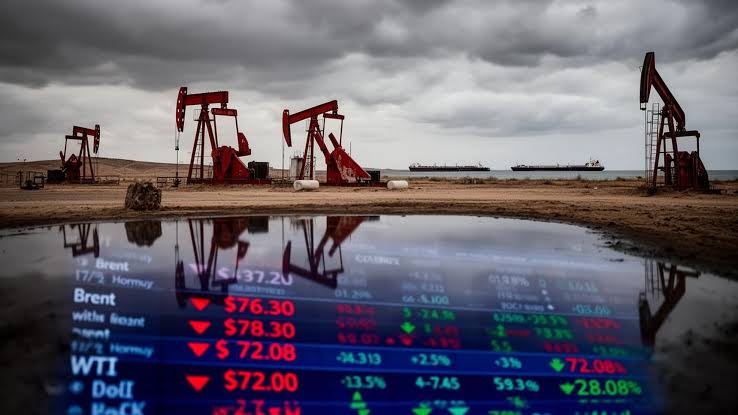
Crude Oil Prices Drop 2% as Inflation Fears Overshadow Middle East Tensions
Quick Reads:
- Brent futures fell $1.72 (2.2%) to settle at $76.30 a barrel
- WTI crude dropped $1.44 (2.0%) to $72.08 a barrel
- Iran struck US military infrastructure in Gulf states, straining a three-week ceasefire
- Strait of Hormuz traffic remains thin, with only one tanker crossing on Thursday
- US Fed minutes revealed mounting inflation concerns from its June meeting
Crude oil prices took a sharp hit on Thursday, sliding about 2 percent as traders shrugged off fresh Middle East military tensions to focus instead on mounting worries over global inflation and its potential drag on oil demand.
Brent futures fell by $1.72, or 2.2 percent, to settle at $76.30 a barrel, while US West Texas Intermediate (WTI) crude dropped $1.44, or 2.0 percent, to close at $72.08 per barrel. The decline came even as Iranian armed forces launched fresh attacks on US military infrastructure in Gulf states, retaliating against earlier American strikes on Iran’s southern coastal and eastern provinces — a development that has further strained a fragile three-week-old ceasefire.
Despite the escalation, the drop in crude oil prices reflects a market more preoccupied with economic headwinds than geopolitical risk. Supply constraints persist, as the ongoing US-Iran conflict has delayed the full reopening of the Strait of Hormuz, a critical corridor through which roughly 20 percent of global oil supplies typically pass. On Thursday, only one tanker, a sanctioned Very Large Crude Carrier, moved through the Iran-controlled route, alongside an Iranian container ship.
By contrast, Bloomberg data showed about 14 commodity-carrying vessels crossed the strait on Wednesday, a steep drop from the daily average of 34 tanker crossings recorded over the past three weeks since the ceasefire, which peaked at 59 crossings on June 24. Still, Axios reported that the US administration believes it retains room for further escalation, since millions of barrels have successfully exited the strait in recent weeks, easing fears of a sharp price spike.
Qatar, a longtime mediator between Washington and Tehran, condemned the attacks on commercial shipping and urged a return to diplomacy, while the foreign ministers of Turkey and Oman also pushed for de-escalation in separate calls with Iran’s Mr Abbas Araqchi.
Adding to the bearish pressure on crude oil prices, minutes from the US Federal Reserve’s June 16–17 meeting revealed growing policymaker concern over inflation. Higher interest rates aimed at taming inflation typically slow economic growth and, in turn, dampen oil demand. Meanwhile, in China, the world’s second-largest economy, producer price inflation surged in June to its highest level in four years, squeezing manufacturers’ margins amid weak domestic demand.