Nigeria is once again talking loudly about women’s political empowerment, but the numbers coming out of the 2027 election season tell a far quieter story.
On one hand, the federal government has announced fresh plans to revive Women Political Empowerment Centres across all six geopolitical zones, an initiative unveiled by the Minister of Women Affairs and Social Development, Imaan Sulaiman-Ibrahim, at the 2026 National Assembly Open Week in Abuja. The centres, to be run in partnership with civil society organisations, are designed to offer leadership training, mentorship, campaign support and technical skills to women hoping to build political careers. According to the minister, the goal is to create “a sustainable pipeline of competent, confident and capable women leaders who will shape Nigeria’s future.” She also renewed calls for legal safeguards around the proposed Electoral College under the Women’s Special Seats Bill, a piece of legislation that would create 12 additional Senate seats, 37 House of Representatives seats and 108 State Houses of Assembly seats reserved for women, with a 16-year sunset clause attached.
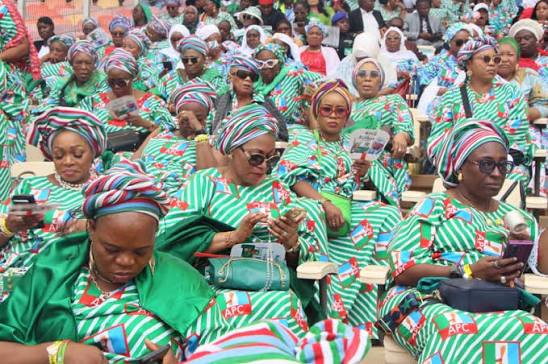
It sounds like real momentum. But on the other hand, the party primaries already underway for 2027 are painting a starkly different picture of what women’s political empowerment actually looks like on the ground. Out of 99 senatorial districts where the All Progressives Congress has produced candidates so far, only two women secured tickets: Senator Idiat Adebule in Lagos West and Ngozi Kene-Chiedu in Anambra Central. In Lagos, one of Nigeria’s most politically consequential states, the APC fielded 24 House of Representatives candidates, and only one, Olabisi Adebanjo, was a woman. The other 23 seats went to men.
This is the contradiction at the heart of Nigeria’s gender politics right now. Party leaders keep making the right noises. APC National Chairman Nentawe Yilwatda has publicly framed gender inclusion as a central pillar of the party’s 2027 strategy, and female deputy governors have pushed for at least 35 percent of elective positions to be reserved for women. Yet when primaries actually happen, those commitments evaporate. Women are not simply underrepresented on the ballot; in many races, they are effectively missing from it altogether.
There is a growing conversation about whether that could change at the very top of the ticket, with names like Abike Dabiri-Erewa, Chairman and CEO of the Nigerians in Diaspora Commission, being floated as a potential governorship contender. Whether or not she runs, the fact that her name keeps coming up says something important: nobody seriously doubts that Nigerian women have the competence and experience to govern. The problem was never capability. It has always been access, and access is controlled by the parties themselves.
That is exactly why the federal government’s renewed push matters, even as it invites scepticism. Training centres, mentorship programmes and a Special Seats Bill can build a pipeline of qualified women, but a pipeline is only useful if parties actually let women through the door at ticket-allocation time. The minister herself acknowledged this tension, insisting that sustained engagement with political leaders has already helped increase the number of female candidates emerging ahead of 2027, and describing women’s political empowerment as “a national development imperative that demands collective commitment from government, political parties, civil society and every Nigerian.”
As 2027 draws closer, the real test will not be found in ministerial speeches or newly opened empowerment centres. It will be found in candidate lists, primary results and the seats women are actually allowed to contest. Nigerians pushing for genuine women’s political empowerment should keep demanding more than assurances from parties like the APC. They should demand proof, measured one ballot at a time.